Imagine walking into an electronics shop—three smartphones catch your eye: a basic one at ₹25,000, a mid-range at ₹35,000, and a premium at ₹50,000. You reach for the ₹35,000 model without a second thought. That’s pricing psychology in action. This feels illogical at first. If people want to save money, why do they keep choosing higher-priced products?
The answer is simple but uncomfortable — people don’t buy based on price, they buy based on perception. High prices don’t scare buyers; they attract them by boosting perceived value. Today, we dive deep into anchoring effect and decoy pricing– tools explaining this magic. Whether you’re a shopkeeper or an e-commerce boss, master these, and watch sales wheel. Price is not just a number; it is a signal. It tells a story about quality, trust, and identity. Once you understand this, you stop thinking like a seller and start thinking like a strategist.
What is Pricing Psychology & Perceived Value?
Pricing psychology is about how people feel about a price, not just how they calculate it. Most buying decisions are not logical calculations. They are fast, emotional judgments supported by small bits of reasoning. Pricing psychology examines the mental shortcuts our brains take when judging a product’s worth. At its heart, it is all about perceived value — the way we judge the quality of something in our mind, which is often different from its actual price or cost. We don’t buy a watch for time; we buy status. Expensive items trigger a dopamine hit, an emotional high linked to our evolutionary past when rare goods meant prestige.
This perceived value drives emotional decisions—buying that premium saree feels like investing in family pride, not just fabric.
Why Expensive Products Sell More
Expensive products sell more because they reduce doubt. A higher price often makes the decision easier, not harder.
Take Apple as an example. There are many smartphones with similar or even better specifications on paper. Yet people consistently choose iPhones at a much higher price. They are not buying just a device. They are buying reliability, ecosystem, and a certain identity. The price reinforces all of that.
The same happens with Rolex. A watch at a fraction of the price can tell time just as accurately. But that’s not the point. The higher price transforms the product into a symbol. It signals success and achievement. The buyer is not comparing features; they are expressing something about themselves.
There is also a deeper psychological layer here. Expensive products feel safer. People assume that if something costs more, it must have gone through better processes, better quality checks, and better thinking. In uncertain situations, people choose the option that reduces risk, even if it costs more
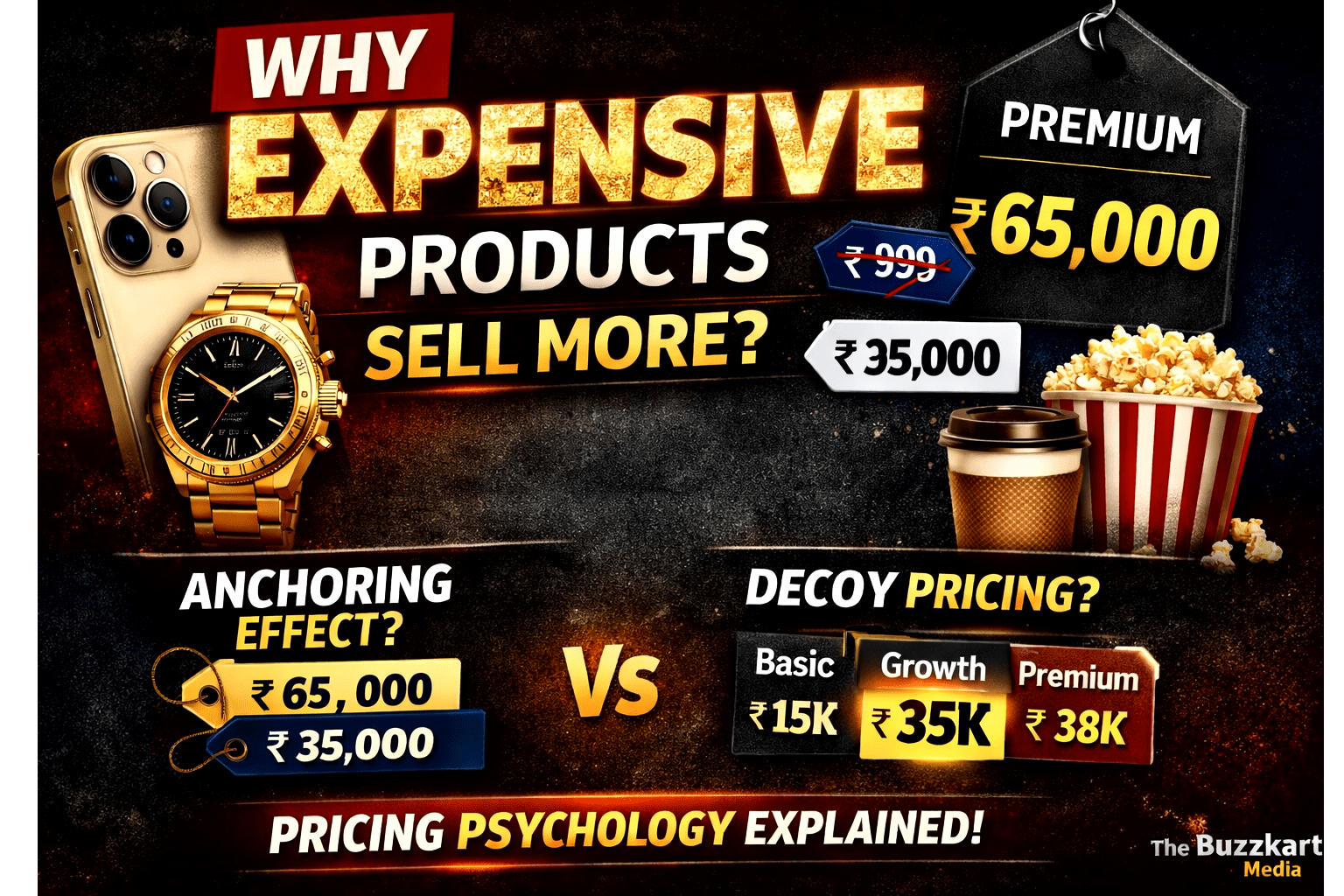
Anchoring Effect — How the First Price Changes Everything
The anchoring effect is one of the most powerful forces in pricing. The first price a customer sees becomes the base in their mind. After that, they compare everything according to it. Like an anchor holding a ship, it fixes our expectations.
For example, when you open a pricing page and see a high-end plan first, your brain quietly accepts it as a benchmark. Now when you look at the middle plan, it doesn’t feel expensive anymore. It feels reasonable.
This is exactly how Netflix structures its plans. The premium plan sets the base price in your mind. Once you see that, the standard plan feels like the best and smartest option. And the cheapest plan looks a bit limited in comparison.
The key here is not manipulation, but framing. You are not changing the product. You are changing how the customer understands its value.
Decoy Pricing — Guiding the Decision Without Forcing It
Decoy pricing works in a simple and smart way.. Instead of directly pushing a customer toward an option, it introduces a third option that makes one of the other choices look better.
Think about a common scenario. You see three options:
Small for ₹200
Medium for ₹450
Large for ₹500
Suddenly, the large option feels like a great deal. The medium option looks awkward — not cheap enough, not valuable enough. So most people move to the large.
Brands like Starbucks use this structure daily. The middle size often acts as a comparison tool rather than a real choice. It exists to make the larger size feel smarter.
What’s interesting is that customers feel in control. They believe they made a rational decision, while in reality, the structure guided them.
When Should You Use These Strategies?
Pricing psychology becomes important whenever you are giving people options. If your business involves packages, subscriptions, or tiered services, these principles are not optional — they are essential. It works best when customers are unsure about value and are looking for signals to guide them.In such cases, pricing becomes a form of communication. It tells the customer what to expect and where to focus.
How to Apply This in Real Life
Start by simplifying your pricing. Three options are enough. More than that creates confusion, and confused people don’t buy.
Your cheapest option should exist, but it should not be too attractive. It should clearly feel limited. Your highest option should act as an anchor. It sets the upper boundary and makes everything else look more reasonable.
The middle option is where your real business happens. This is the plan you want most people to choose. So it should feel balanced — strong value without being overwhelming.
Another important point is how you describe your offer. Don’t focus on features. Features are logical, and logic rarely drives decisions. Focus on outcomes. Instead of saying what you offer, focus on what result people will get.
Don’t say “we provide services.”
Say “we help you get real results and solve your problem.”
This way, people stop thinking about cost and start seeing the value.
Where You See This in Daily Life
Once you start noticing pricing psychology, you’ll see it everywhere. It’s in subscription platforms, restaurant menus, SaaS tools, and even local service providers. It’s not limited to big brands. Even a small agency or freelancer can use these principles to position themselves better and attract higher-quality clients.
Common Mistakes Businesses Make
Many businesses try to compete by lowering prices. This often backfires. Lower prices attract price-sensitive customers who are harder to satisfy and more likely to leave. Another mistake is offering too many options. When customers have too many choices, they delay the decision or avoid it completely. Some businesses also fail to create a clear difference between plans. If everything looks similar, customers don’t see a reason to upgrade.
Final Thought
Pricing is not about numbers. It is about perception. The moment you understand this, your entire approach to selling changes. People are not trying to find the cheapest option. They are trying to make a decision that feels right. Your job is to make that decision easy.
FAQ Pricing Psychology & Perceived Value?
Why do expensive products feel more trustworthy?
Because price acts as a shortcut for quality. It reduces uncertainty and signals reliability.
Is it risky to increase prices?
Only if the perceived value is low. If your positioning and communication are strong, higher prices can actually improve conversions.
How many pricing options should I offer?
Three is ideal. It allows comparison without overwhelming the customer.
What matters more, price or value?
Value. But value must be clearly communicated otherwise price becomes the only factor.
Make people feel something otherwise they’ll forget everything.
Follow The BuzzKart Media