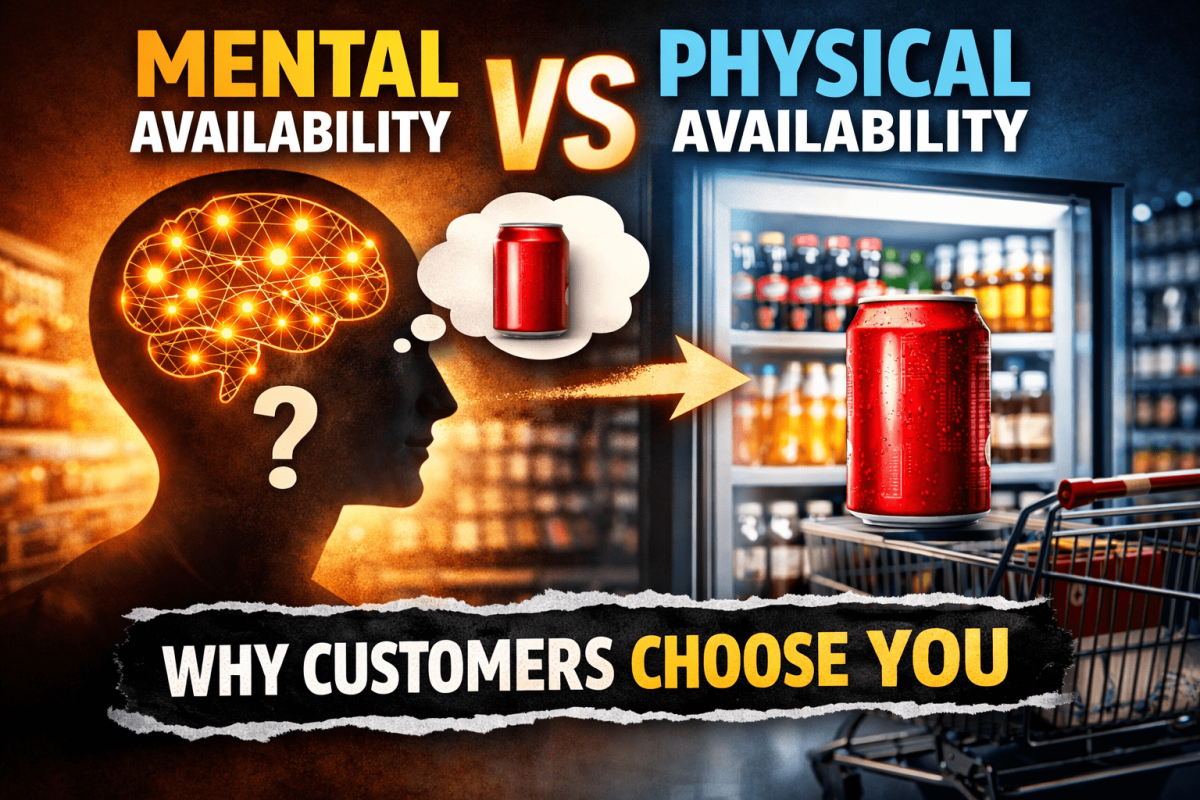
Mental availability vs physical availability explains why customers choose familiar brands instead of the best ones.
It looks like a simple decision, but it is actually controlled by how our brain works.
The Decision That Happens Before the Decision
It looked like a simple moment.
You walk into a shop. You’re tired, slightly distracted, not in the mood to think. You ask for a cold drink and say a brand name almost instantly.
It feels like a choice. But if you slow that moment down, you’ll notice something uncomfortable.
You didn’t evaluate, compare. You didn’t explore.
The decision was already made.
Not in the store, but inside your mind—built silently over time through repetition, exposure, and emotional association.
This is where most marketers get it wrong. They focus on persuasion, while the real game is already decided long before persuasion even begins.
Mental Availability: How Brands Become “Default Choices”
Mental availability is not about awareness in the traditional sense. It is about retrievability under pressure.
In simple terms, it answers one question:
When a buying situation occurs, how easily does your brand come to mind?
The human brain is not designed for constant analysis. It is designed for efficiency. Faced with too many options, it relies on memory shortcuts. These shortcuts are built through repeated exposure, cultural presence, and emotional relevance.
That is why, in real life, people don’t search the entire category. They recall a few options that feel familiar and safe.
This is not preference. This is cognitive efficiency.
A person thinking “I want something cold” is not entering a rational decision tree. They are activating a memory network. And whichever brand has the strongest, most accessible memory structure… gets chosen first.
Imagine :–
You walk into a theatre and didn’t plan anything. You’re just thirsty.
You say:“Coke.”
Not because you checked options..But because it came to your mind first.
That’s mental availability.
Physical Availability: The Constraint That Converts Memory Into Revenue
Now shift the same scenario slightly.
The brand that came to mind is not available.
At this point, something critical happens. The brain does not restart the entire decision process. It simply selects the next most convenient option.
This is physical availability.
It is not glamorous. It does not rely on storytelling or creativity. But it is brutally effective.
Physical availability answers a different question:
When the customer is ready to buy, are you easy to find, access, and purchase?
Because no matter how strong your mental presence is, if you are not physically present in that moment, you are eliminated from the decision.
This is why distribution is not a backend function. It is a frontline growth driver.
Now imagine this:
The shopkeeper says, “Coke isn’t available.”
You pause for 2 seconds…
And then say:“Give me a Pepsi.”
You didn’t go home and didn’t search for better.
You chose what was available.
That’s physical availability.
That 2-second switch is where brands win or lose.
Mental Availability vs Physical Availability: The Interaction Effect
Mental availability and physical availability are often treated as separate strategies. In reality, they are multiplicative forces, not additive ones.
A brand that is highly memorable but poorly distributed creates frustration and substitution.
A brand that is widely available but mentally weak becomes invisible despite its presence.
The highest-performing brands operate differently. They engineer both simultaneously.
They ensure that when the buying trigger occurs, they are not only the first thought—but also the easiest action.
This is where market dominance is created.
Why “Better Products” Lose to “Easier Choices”
One of the hardest truths for founders and creators to accept is this:
Customers do not reward superiority. They reward simplicity.
A technically better product, with stronger features and more competitive pricing, can still lose consistently to an inferior alternative if it lacks mental and physical availability.
This is not irrational behavior. It is predictable behavior.
The brain optimizes for:
Reduced cognitive effort
Lower perceived risk
Faster decision-making
Familiarity reduces uncertainty. Availability reduces friction.
Together, they create what feels like a “natural choice,” even when it is not objectively optimal.
The Deeper Psychology: Cognitive Ease, Not Rational Evaluation
At the core of this phenomenon lies a principle known as cognitive ease.
When something is easy to recall and easy to access, the brain interprets it as trustworthy and preferable. This happens subconsciously, without deliberate reasoning.
In contrast, unfamiliar or hard-to-find options create cognitive strain. And the brain instinctively avoids strain.
So instead of asking, “What is the best option?” the brain reframes the decision into:
“What is the easiest option that feels right?”
This subtle shift explains why most marketing strategies fail. They attempt to convince, while the brain is trying to simplify.
Strategic Implication: Marketing Is Memory Engineering + Access Design
If you step back and look at this through a strategic lens, marketing is not primarily about persuasion.
It is about two things:
First, building memory structures so your brand becomes an automatic recall in relevant situations.
Second, designing access pathways so your brand is effortlessly available at the point of purchase.
Everything else—creativity, messaging, performance marketing—sits on top of these two foundations.Without them, even the most brilliant campaigns collapse.
How to Build Mental Availability Intentionally
Mental availability is not luck. It is engineered through consistency and repetition.
A brand must show up repeatedly in the same context, with recognizable signals, until it becomes mentally encoded.
This includes consistent messaging, visual identity, emotional positioning, and presence across touchpoints.
The goal is not just to be seen, but to be remembered in buying situations.
How to Build Physical Availability Systematically
Physical availability is about reducing friction at every possible point.
This means expanding distribution channels, increasing visibility where decisions happen, and ensuring accessibility across platforms and locations.
In digital environments, it translates to search presence, platform coverage, and fast, seamless user experience
In physical markets, it means shelf presence, geographic reach, and supply reliability.
The principle remains the same: be there when the decision is made.
Mental Availability and Physical Availability in Marketing: How Brands Become Default Choices
Most brands compete on surface-level differentiation. Features, pricing, messaging.
But the real competitive advantage operates at a deeper level. It is about occupying mental space and physical space simultaneously. Because when a brand achieves both, it stops competing actively.
It becomes the default. And default choices do not get questioned. This is why mental availability vs physical availability plays a critical role in real buying decisions.
FAQ Section
What is the difference between mental availability and physical availability?
Mental availability refers to how easily a brand comes to mind in a buying situation, while physical availability refers to how easily the product can be found and purchased at that moment.
Which matters more: mental or physical availability?
Neither works effectively in isolation. Mental availability drives preference, while physical availability enables purchase. The highest growth occurs when both are strong.
Why do customers choose familiar brands over better ones?
Familiar brands reduce cognitive effort and perceived risk. The brain prefers options that are easy to recall and feel safe, even if they are not objectively superior.
Can small businesses build mental availability?
Yes, through consistent messaging, niche focus, repeated exposure, and emotional relevance. Over time, even small brands can become strong in specific contexts.
How can I improve physical availability for my brand?
By increasing distribution channels, improving accessibility, ensuring presence where customers make decisions, and reducing friction in the buying process.
Final Insight
Customers do not wake up and analyze your brand. They move through moments.
And in those moments, they reach for what feels familiar and what is easily available.
If you are not in their mind, you are not considered.
If you are not in their reach, you are not chosen.
Everything else is secondary.
The brands that understand this do not chase attention.
They build memory.
They build presence.
And when the moment comes, they are simply… there.
“Make people feel something otherwise they’ll forget everything.”
Follow The Buzzkart Media.